
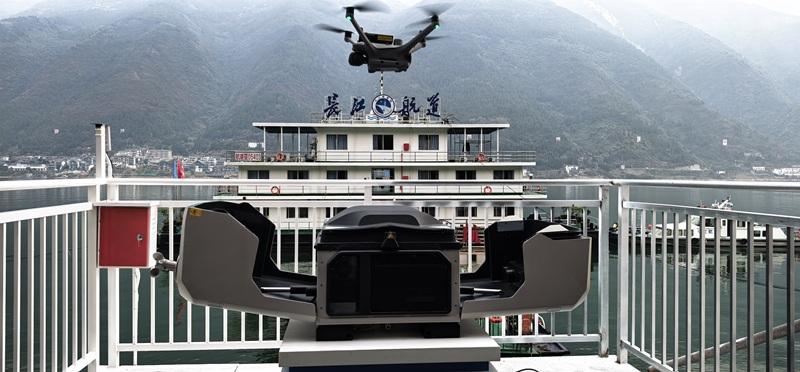
Recently, Changjiang Wanzhou Waterway Division successfully deployed an intelligent patrol UAV in the key waters of Wushan section and completed its maiden test flight. It is reported that this intelligent patrol UAV is the first of its kind in the high-steep hazardous rock sections of the Three Gorges Reservoir area, marking the official launch of the “intelligent era” for waterway inspection by Changjiang Wanzhou Waterway Division. It represents a critical step forward in advancing the intelligent management of waterway maintenance and the development of an integrated “water-land-air” monitoring system.
Technology-Driven Solutions to Overcome Traditional Inspection Challenges
Wushan section, located deep within the WuXia Gorge in the upper reaches of the Yangtze River, spans 38 kilometers of waterway, featured by complex reservoir-style deep-water channels, with water level fluctuations of up to 30 meters between flood and non-flood seasons, and including 29 yellow-alert geological hazard sites. Traditional manual inspections are faced with challenges such as low efficiency, significant blind spots, and high safety risks. The newly deployed intelligent patrol UAV is equipped with integrated high-precision positioning, AI image recognition, laser ranging, and thermal imaging sensors, enabling it to adapt to the complex and variable meteorological conditions of the canyon. By following pre-set flight paths and executing targeted missions, the UAV can complete inspections of a 25-kilometer waterway segment in a single flight. It intelligently identifies navigation aid displacement, water depth changes, obstruction accumulation, and geological hazard risks, improving inspection efficiency by over four times compared to manual methods and enabling round-the-clock autonomous patrols.
Intelligent Hub: Building a Dynamic Monitoring Network
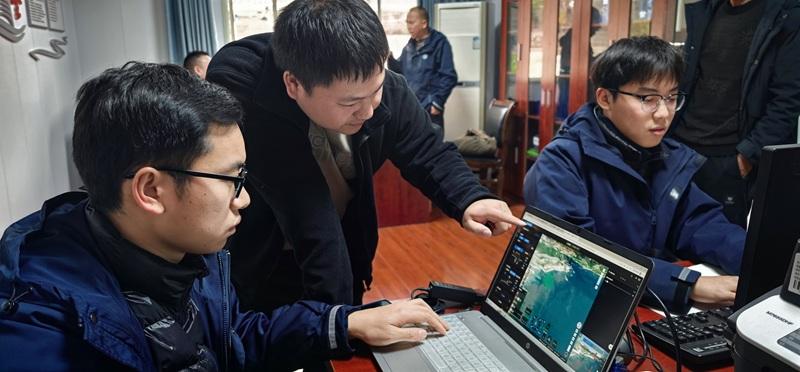
In the office of Wushan maintenance base, real-time 3D imagery of the waterway transmitted by the UAV is displayed on computer screens. Technicians explain that the system adopts a “cloud-edge computing” architecture, with which data could be collected by the UAV transmitted via an 8-antenna system over distances of up to 25 kilometers. The system is also deeply integrated with the digital waterway monitoring platform and electronic navigation charts, forming a closed-loop management mechanism of “UAV patrol-intelligent analysis-rapid response.” This truly achieves waterway management that is “visible, controllable, and service-oriented.”
Green and Low-Carbon: Fulfilling the Mission of Ecological Protection
As important practitioner of green development in the Yangtze River Economic Belt, Changjiang Wanzhou Waterway Division adhers to the “environment-first” principle in its selection of equipment. The unmanned aerial vehicle (UAV) adopts an electric vertical take-off and landing (eVTOL) design, offering up to one hour of flight time on a single charge, which can be recharged in just 20 minutes and quickly redeployed for subsequent missions. Compared with traditional fuel-powered models, its flight noise is reduced by 60 percent. Equipped with an AI-based identification module, UAV can accurately detect floating debris and surface obstructions, providing strong technical support for ecological protection along the Yangtze River.
“The shift from ‘manual patrols’ to ‘drone patrols’ represents not only the upgrading in technical tools, but also the profound transformation in management philosophy and working models,” said a responsible official of the authority. Looking ahead, Changjiang Wanzhou Waterway Division plans to further advance the diversified “UAV+” applications, expanding integrated functions in areas such as emergency response and rescue, hydrological monitoring, and waterway surveying and mapping. By gradually achieving full UAV coverage of key navigation sections, the authority aims to build a benchmark “smart waterway” in the upper reaches of the Yangtze River.
Source from: China Transportation News Network