
On 9th September the High-Quality Development Forum for Inland Waterway Transportation (2025) was held in Chongqing. Organized by Changjiang River Administration of Navigational Affairs, MOT and the China Institute of Navigation (CIN), and themed “New Achievements, New Momentum, New Vision—Pathways to Chinese-Modernized Inland Waterway Transportation”, the Forum brought together representatives of more than 200 organizations from across the country to chart the course for high-quality development for inland waterway transportation during the 15th Five-Year Plan period.
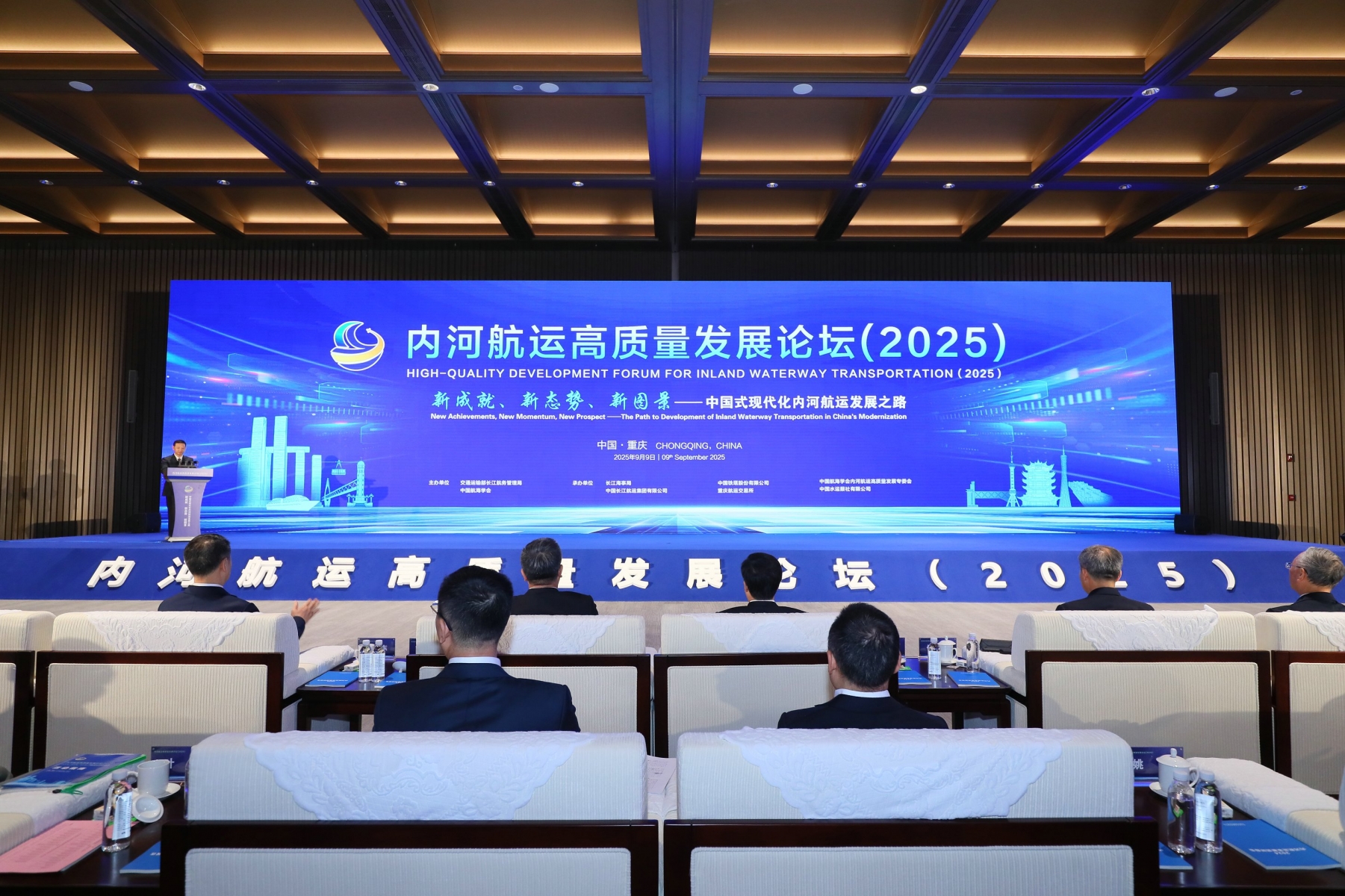
Hu Henghua, Mayor of Chongqing Municipal People’s Government, attended the Forum. Fu Xuyin, Vice-Minister of Transport, Zheng Xiangdong, Vice-Mayor of Chongqing, and He Jianzhong, President of CIN, delivered addresses.
Fu Xuyin said that, guided by the goal of building China into a country with strong transport networks, the Ministry will accelerate both “hard connectivity” and “soft upgrading” of inland waterway transportation, promote all-factor, whole-chain, high-quality development, and establish a modern inland waterway transportation system that is smooth and efficient, green and smart, safe and resilient, and well supported. He emphasized that high-quality development must be underpinned by high-level safety, based on a high-grade waterway network, supported by highly efficient organization and services, oriented towards green and smart solutions, and aimed at serving economic and social development. He expressed the hope that the Forum will pool ideas and concerted efforts to speed up this development.
Zheng Xiangdong said the Chongqing Municipal Party Committee and Government place high-quality development of inland waterway transportation high on their agenda for serving national strategies and the city’s overall development. The upstream Yangtze shipping center is taking shape. With inland waterway transportation now facing an unprecedented strategic opportunity, Chongqing will focus on its “two major orientations” and its upstream responsibilities, systematically advance the “Water-Transportation Chongqing” program, which will build on waterway corridors, hinge on port hubs, focus on industrial demand, and driven by smart innovation, so as to turn Chongqing into an international, modern, digital and green shipping center on the upper Yangtze.
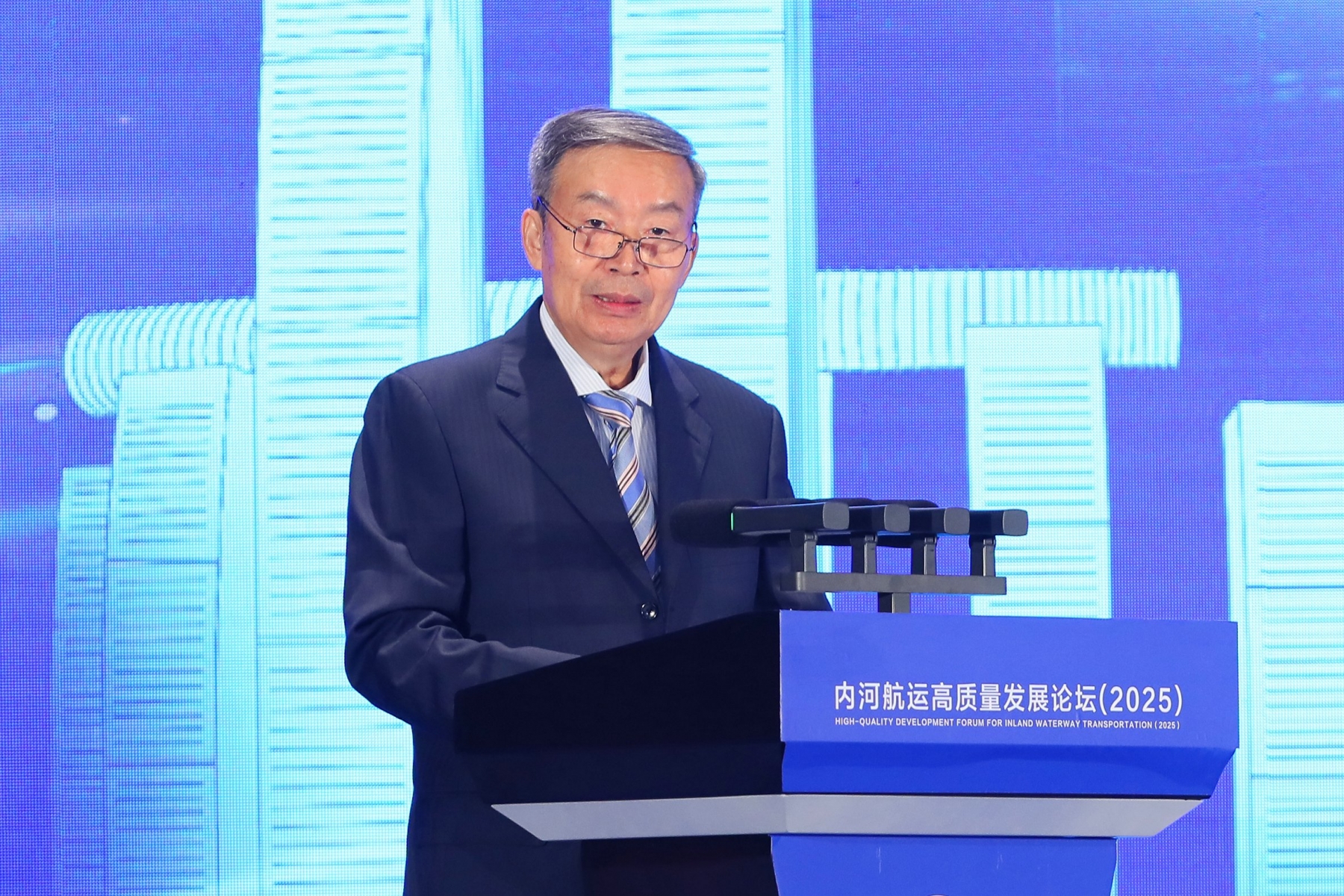
He Jianzhong, President of the China Institute of Navigation
He Jianzhong emphasized five key directions: First, adhere to innovation-driven development to shape new growth momentum. Technological innovation must be placed at the core, with a focus on key areas such as green ships, smart ports, and intelligent shipping. Accelerate the deep integration of big data, artificial intelligence, the Internet of Things, and other next-generation information technologies with inland waterway transport, aiming to build a modern inland shipping system that is efficient, green, smart, safe, resilient, and reliable. Second, practice green and low-carbon development to protect the ecological environment. Comprehensively strengthen ship pollution prevention, promote the construction of green infrastructure and ecological revetment technologies, and protect aquatic biodiversity. Actively adjust the energy structure, significantly reduce carbon emission intensity, and ensure that the "golden waterways" complement the "green mountains and clear waters," contributing to the building of a Beautiful China. Third, emphasize coordination and balance to serve national strategies. Further optimize the layout of the waterway network, accelerate the development and construction of waterway networks, eliminate bottlenecks and blockages, and address the "last mile" challenges. Strengthen effective connections with coastal ports, highways, and railways to build a modern comprehensive three-dimensional transport network. Vigorously develop multimodal transport to effectively reduce logistics costs, fully leverage the advantages of river-sea direct transport, and ensure that the benefits of inland waterway development are shared more equitably by people along the routes, promoting urban-rural integration and regional balanced development. Fourth, strengthen safety foundations and enhance emergency response capabilities. Build a more comprehensive risk prevention and control system for inland waterway safety, enhance the resilience of infrastructure, address weaknesses in emergency rescue bases and capabilities, and improve waterway maintenance and navigation support. Strengthen ship safety supervision and crew training, and apply advanced technologies to enhance early warning, pre-control, and emergency response capabilities, ensuring the safety and smooth operation of water transport channels and safeguarding people's lives and property. Fifth, deepen openness and cooperation to promote connectivity. While building on domestic foundations, actively participate in international shipping affairs and cooperation, and learn from world-class advanced experiences and technologies. Leverage internationally influential inland waterways such as the Yangtze River, Pearl River, Beijing-Hangzhou Grand Canal, and Huai River to better align with the Belt and Road Initiative, serve the new development paradigm of dual circulation, and enhance the international competitiveness and influence of China's inland waterway transport through open cooperation.
At the main forum, Professor Yan Xinping, Academician of the Chinese Academy of Engineering and Director of the Academic Committee of Wuhan University of Technology, delivered an academic report titled "Research Status and Prospects of Intelligent Green Inland Ship Technology."
The forum was chaired by Liu Liang, Director of the Yangtze River Maritime Affairs Administration of the Ministry of Transport. Deputy Directors Guo Qingsong of the Water Transport Bureau of the Ministry of Transport and Liu Dong of the Comprehensive Planning Department conducted policy promotion sessions on the "Opinions on Promoting High-Quality Development of Inland Waterway Transport" and the "Action Plan for Advancing the Connectivity Project of the Inland Water Transport System," respectively. He Qing, Director of the Chongqing Municipal Transportation Commission, introduced the development of the "Water Transport Chongqing" initiative. Speeches were also delivered by distinguished guests including Zhuo Li, Executive Deputy Director of the China Maritime Search and Rescue Center; Wang Haiyu, Director of the Yangtze River Maritime Safety Administration; Liu Xin, President of the Transport Planning and Research Institute of the Ministry of Transport; Li Xuesong, Director of the Pearl River Waterways Administration of the Ministry of Transport; Chen Jiding, President of the China Academy of Transportation Sciences; Ding Lei, General Manager of China Changjiang National Shipping Group; and Yan Zhiyin, Chief Compliance Officer of China Tower Smart Connectivity Technologies Co., Ltd.
During the forum, the Yangtze River Maritime Affairs Administration of the Ministry of Transport signed the "Cooperation Memorandum on Jointly Promoting the Digital Transformation and Upgrading of Water Transport Infrastructure in the Yangtze River Basin" with transportation departments from 14 provinces (municipalities) in the Yangtze River Basin. The "Yangtze River Green Ship Monitoring System" and the "Yangtze River Ship Energy Refueling System" were officially launched, providing robust support for the green and intelligent development of Yangtze River shipping.
The forum also featured four thematic sessions focusing on smart logistics, green shipping and transportation-cultural tourism integration, intelligent sensing and communication, and shipping finance.