
On the afternoon of May 20, 2026, a delegation led by Li Shixin, Executive Vice Chairman of China Institute of Navigation, together with Secretary-General Liu Shun, Deputy Secretaries-General Liu Ying and Yue Peng, visited China Classification Society (CCS) for exchange and discussion. Zhao Yan, President of CCS, Wang Hongwei, Vice President, Li Zhiwei, Director of the Ship Survey Technical Guidance Department, along with heads of relevant departments, attended the meeting.
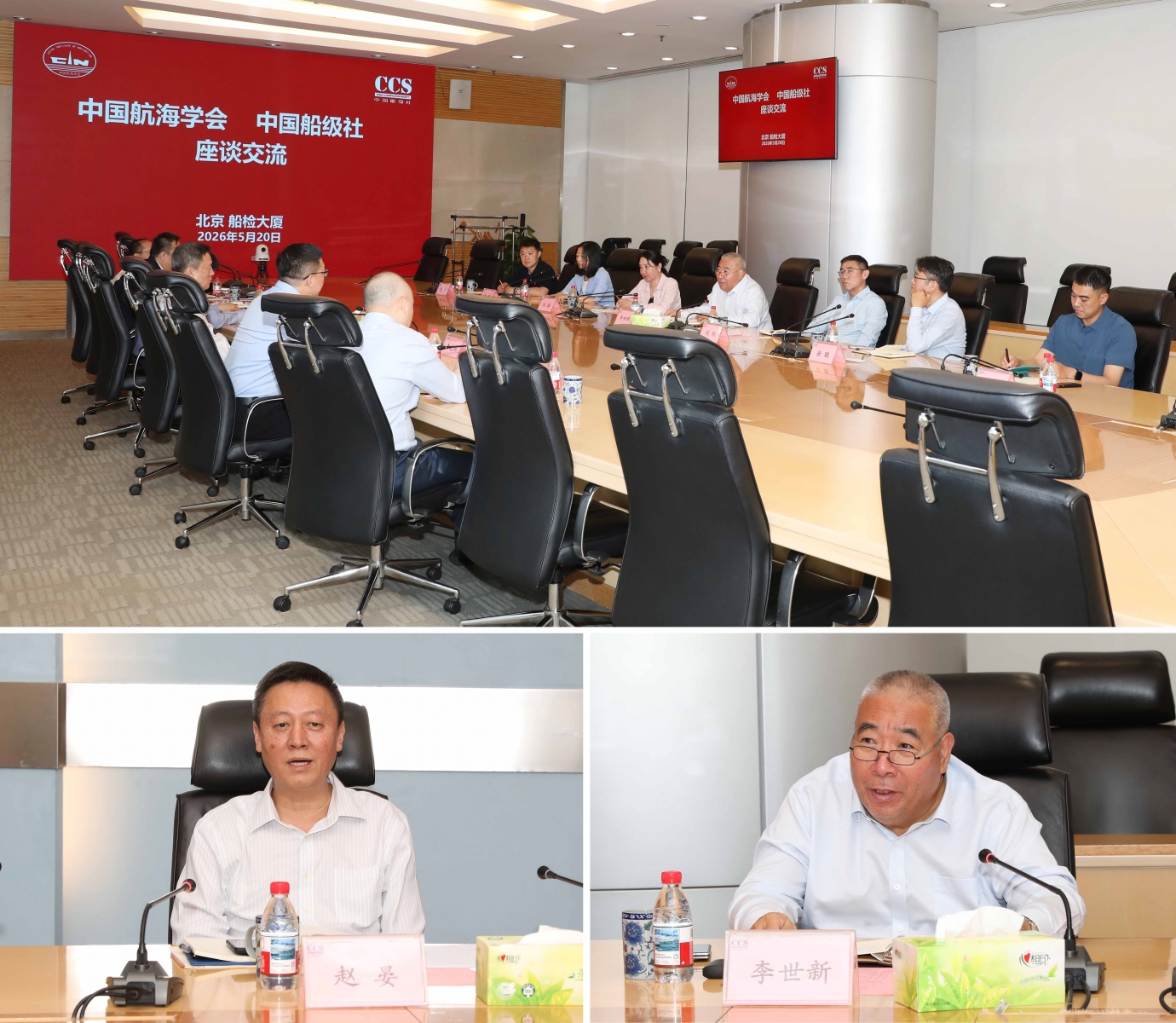
President Zhao Yan, on behalf of China Classification Society (CCS), extended a warm welcome to Executive Vice Chairman Li Shixin and his delegation. During the meeting, he provided an overview of CCS's business development and its latest progress in ship survey, classification services, and the R&D and application of green and intelligent technologies. He also expressed CCS's continued commitment to supporting the Institute's various endeavors, and its active participation in the development of specialized committees, science and technology awards, academic exchanges, and journal construction.
Secretary-General Liu Shun introduced the positive progress that China Institute of Navigation has made in various business endeavors in recent years. The two sides conducted in-depth exchanges on topics including maritime science and technology innovation, application of rules and standards, green and low-carbon shipping, and maritime talent cultivation.
Executive Vice Chairman Li Shixin expressed gratitude to China Classification Society (CCS) for its longstanding and strong support to the Institute. He emphasized that, as an important member unit of the Institute, CCS shares a solid foundation and broad prospects for cooperation with the Institute. The Institute will fully leverage its platform and resource advantages, continuously optimize member services, and deepen collaboration with CCS in areas such as academic exchanges, evaluation of scientific and technological achievements, standards development, talent cultivation, and journal construction. Together, they aim to make greater contributions to promoting the high-quality development of the maritime industry and supporting the building of China into a leading maritime nation.